Deepa Mehta, a prominent film director has not only become the voice of new India but has also become one of the most controversial and sought-after directors in the film industry. Described as "Canada's most internationally renowned woman film-maker" (Levitin, An Introduction..., p 273) she was born in 1950 in Amritsar, a city on India's border with Pakistan. She embarked her film career as a screenwriter for children’s films and gradually, made her mark in the world for directing the trilogy- “Fire”, “Earth” and “Water”.
Her brilliant depiction of rural India’s obsolete customs and traditions combined with themes such as lesbianism (Fire), racism and the divide between India and Pakistan (Earth) has shaken India to its core. Although the movies were the talk of the town in both Canada and the United States, it left India speechless.
The movie Fire, revolves around two women (Radha and Sita), suffocated and suppressed by the customary Indian traditions of fulfilling the duties of an ideal Indian housewife, break the barriers of their heterosexual unions and lurk over to the other side in hopes of finding solace, freedom and pleasure.
The movie received most of its recognition due to the controversies it stirred amongst the Hindu fundamentalists who were successful in banning the movie from the theaters altogether. The movie was first passed uncut by the India’s censor board in May 1998 with a rating of ‘A’ (adult) only on the condition that the protagonist’s name is changed from Sita to Nita. The success of the movie attracted the attention of the Hindu fundamentalist group- Shiv Senas. Reports suggested two hundred of them stormed a Cinemax theatre in suburban town in Mumbai smashed glass panes, burned posters and compelled the managers to refund the tickets to the public
The 1999 edition of the Human Rights Watch World Report notes: "In December 1998, the award-winning film Fire, by director Deepa Mehta, was recalled from theatres after Shiv Sena (Hindu fundamentalist group) activists vandalized at least fifteen cinemas where it was playing.” However, the more interesting part to note is that the Shiv Sena said there would have been no objection to the lesbian relationship if the women were Muslim. To put this in a more western perspective, one could draw parallels with Ang Lee's Brokeback Mountain (2005), drawing controversy not so much because it featured a homosexual relationship, but rather because the homosexuals were cowboys, a fact which destabilized some cultural codes which, up until that point, would not have been the subject that kind of "attack" in the mainstream.
Soon, after much convincing, the Supreme Court allowed the movie to be re-released uncut in India which became a and it enjoyed a significant amount of acclaim both at home and overseas by whisking away awards such as the ‘Audience Award’ for its outstanding narrative feature in the L.A. Outfest and International Independent Award in the Mannheim-Heidelberg International Film festival.
Slumdog Millionaire- Hit in the West but Died in the East!
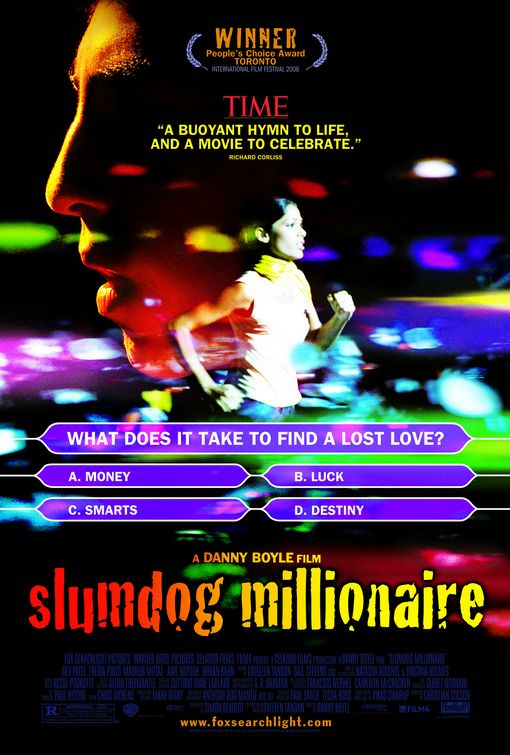
In 2008, Danny Boyle directed a movie called Slumdog Millionaire (SM) which created a huge sensation around the world as it swooped several awards and honors. On February 22nd 2009, this movie won eight out of ten academy awards not to mention the Golden Globe award, the BAFTA award and the Critic’s Choice Awards. The movie was based on a book called ‘Q and A’ written by an Indian author, Vikas Swarup. Set in one of the bustling cities in India, Bombay (Mumbai), the movie projects India as backward and still underdeveloped nation.
The basic plot of the movie revolves around the story of a young boy (Jamal) who was raised in the slums and how his life takes an excited and unpredictable twist as he wins in the show ‘Who Wants to be a Millionaire.’ Due to his background and the fact that he is uneducated, he is suspected of cheating during the show especially when he wins 1 million Rupees and is ready for the 2 million. The movie progresses and unfolds itself as he tries to prove that he is innocent when interrogated by the police. His life experiences during his time in the slums, people he had encountered along the way and memories that have been burned in his mind are the reasons how he was able to answer all the questions correctly.
At heart SM is a love story with the director treating it as a bollywood movie. However, scenes of the movie expose the slums in Mumbai (Dharawi- largest slum in Asia), corruption, underworld dons, child prostitution and other ailments that are common in any underdeveloped nation which bring about the dark and gory element to the movie. When the movie first came out, people in India were ecstatic about all the attention it had already received from the west, however, when the unflattering scenes of India came on, Indians were quick to condemned it. Although it had received great acclimation from viewers and critics here, it performed poorly in India, Mumbai in particular. Arindam Chaudhuri, in The Times of India (February 2nd 2008), excoriated that the film “sucks,” describing the movie as “A phony poseur that has been made only to mock India for the viewing pleasure of the First World!!” People felt it was not only unauthentic but were somehow not able to connect to the characters as it was hard for people to picture slum children speaking in English. Another reason why this movie failed to move the Indian majority was because of how Mumbai was portrayed, some calling it poverty porn. Soon more and more controversies surfaced as people who made this movie were accused of minting money and fortune by highlighting and projecting India’s weakness, distorting the truth and exploiting another culture. Others pointed out that the child actors didn’t receive the fame and fortune Boyle promised.
Although people in India were disappointed with the way the film was directed, they had to understand and eventually give in to the fact that the movie in fact did show the true face of the slums in India, bold but not beautiful!
Bollywood, commonly known as Hindi (Indian) cinema captures a wide array of audiences varying from the masses to one of the most affluent people in the world. Bollywood is one of the biggest film producers in India thus making it one of the largest centers of film production in the world. Initially, the Bollywood movies studied issues of the caste system and the Indian culture. Bollywood actually grew in the 1990s by releasing over 200 movies in one year (1991). This industry captured international audiences (Eastern Europe) with the release of Raj Kapoor’s movies in the 1950s but in 1991, ‘Dilwale Dulhaniya Le Jayenge’ (lover will take his bride) made its presence in the western world. As the cinema grew, magazine publications such as Stardust and Filmfare also became popular.
On an average of one thousand movies come out every year in different languages, out of which six hundred are in Hindi (national language in India which is also understood in Pakistan) and Telugu (one of the Indian dialects).Besides being popular in the Indian Diaspora, Bollywood has also made a mark in far off locations such as Egypt (Amitabh Bachchan is very popular here), Senegal and Russia (Raj Kumar’s movies are very prominent here). In Asia alone, Bollywood is mega popular in countries such as Pakistan, Bangladesh, Nepal and Sri Lanka.
The plots of most of these movies usually revolve around a standard story line with minor variations. They are often melodramatic with love triangles, angry parents, kidnappers, political corruptions all combined with romance and comedy. The cast and crew are picked from beauty pageants, modeling agencies, sons and daughters of previous actors, however, like Hollywood, very few make it to the top. The life of the actors is usually very temporary. The popularity of the stars rise and fall based on the demand they have or how they have performed in their previous movies making their stardom very fickle. But there have been a handful of actors that stuck through the controversies and the ups and downs. Sharukh khan also known as ‘King Khan’ and Amitabh Bachchan (‘Big B’) are one of these actors.
Bollywood movies are also called mini musicals as a typical Hindi movie would have at least 2 or more songs. The songs play a vital role because they are the ones that make the movie popular as people generally associate the movies with the songs.
Songs from the movie are often prerecorded by professional playback singers with the actors lip-singing to the song on screen. The dancing, costumes and setting of these songs in these movies are usually the highlights of the movie. Understanding the dance sequences is as important as the songs. Dancing has adapted to modern times, the older movies had dancing that mirrored the classical dance techniques. Now, with the prominent western influence in India, the dances have incorporated the western hip and pop moves. The song and dance sequences are often unrealistic since the location, costumes and time changes in the matter of a few versus.
Today, Bollywood has become more popular with the release of Slumdog Millionaire. Although directed by a foreigner (Danny Boyle), the setting is in Bombay (Mumbai), India, with an Indian cast and crew and ending with a song and dance sequence. Although the movie gained a negative reception in India, it placed music directors such as A.R. Rehman on the map.